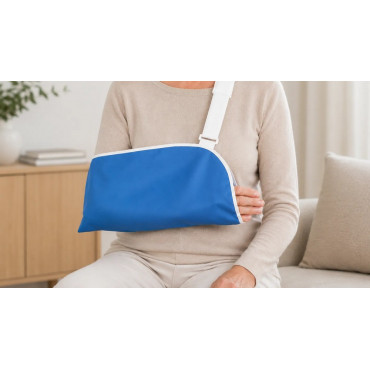
A hand injury, bruise, sprain, dislocation or fracture can significantly limit your usual activity. In such situations, it is important not only to follow the doctor's recommendations, but also to provide the injured limb with the correct position and necessary support. One of the simple and convenient means for this is a supporting hand bandage, or, as it is also called, a handkerchief bandage.
Such a product helps to maintain the hand in a physiologically comfortable position, reduce the load on the injured limb and make everyday movement more comfortable during the recovery period.
When is a handkerchief bandage needed?
The need to fix the hand may arise in various circumstances. In particular, a support may be recommended after shoulder, elbow, or forearm injuries, during recovery from fractures or dislocations, and after some surgical procedures.
The main task of a sling is to support the weight of the arm and prevent it from hanging freely while walking or performing everyday tasks. At the same time, the specific type of fixation depends on the nature of the injury. For example, if local stabilization of the elbow joint is required, the doctor may recommend an elbow joint orthosis. For other situations, shoulder, wrist, or forearm braces can be used.
How is a sling different from other bandages?
Not all upper limb braces perform the same function. You should choose a product not only based on its appearance, but primarily based on the area that needs to be supported.
For example:
- An elbow brace is designed to support and stabilize the elbow joint;
- A shoulder brace is used to support the shoulder joint and upper arm;
- Wrist braces help limit unwanted movements in the wrist area;
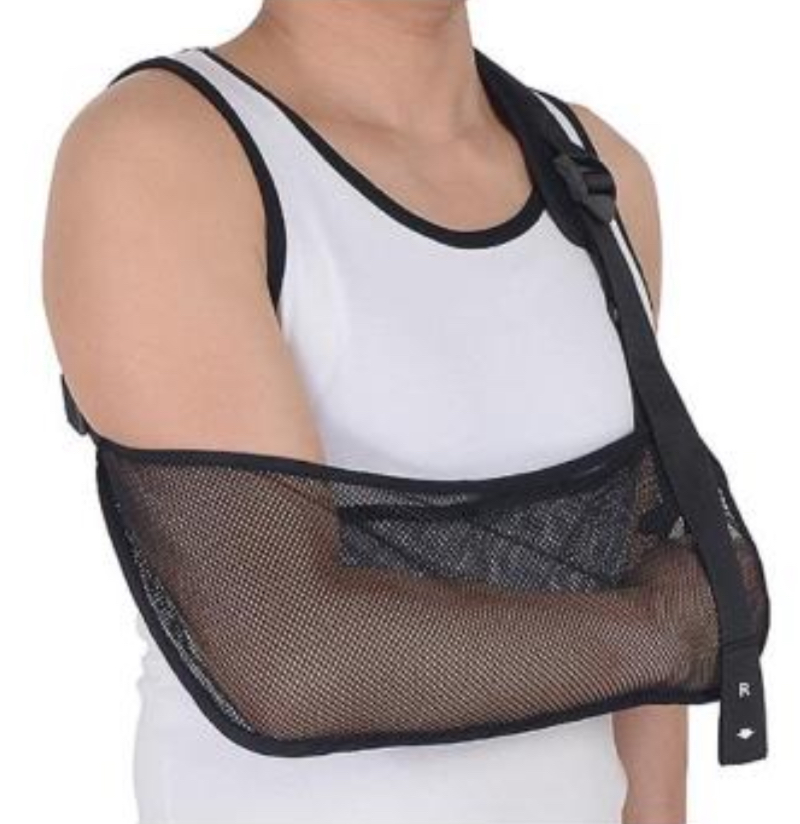
- A support scarf supports the arm as a whole, reducing the load on it.
Therefore, you should not replace one type of orthopedic product with another on your own. If your doctor has prescribed a specific type of fixation, you should follow his recommendations.
How to choose a support bandage for your hand?
Before you buy a hand bandage, pay attention to several important characteristics.
-
Size and adjustability. The support should support your hand, but not create excessive pressure. Adjustable elements allow you to adapt the product to the individual parameters of the user and ensure a comfortable position of the limb.
-
Material. Since the bandage can be used for a long time, it is important that the material is pleasant to the skin, does not rub or create unnecessary discomfort.
-
Design. The bandage-scarf should reliably support the arm and at the same time not interfere with walking, sitting or performing simple everyday tasks.
-
Purpose. Before buying, you need to determine which area needs to be fixed. If you need support for the entire arm, a bandage-scarf may be suitable. If the problem is localized to a specific joint, it is more appropriate to consider a specialized orthosis.
How to wear a handkerchief correctly?
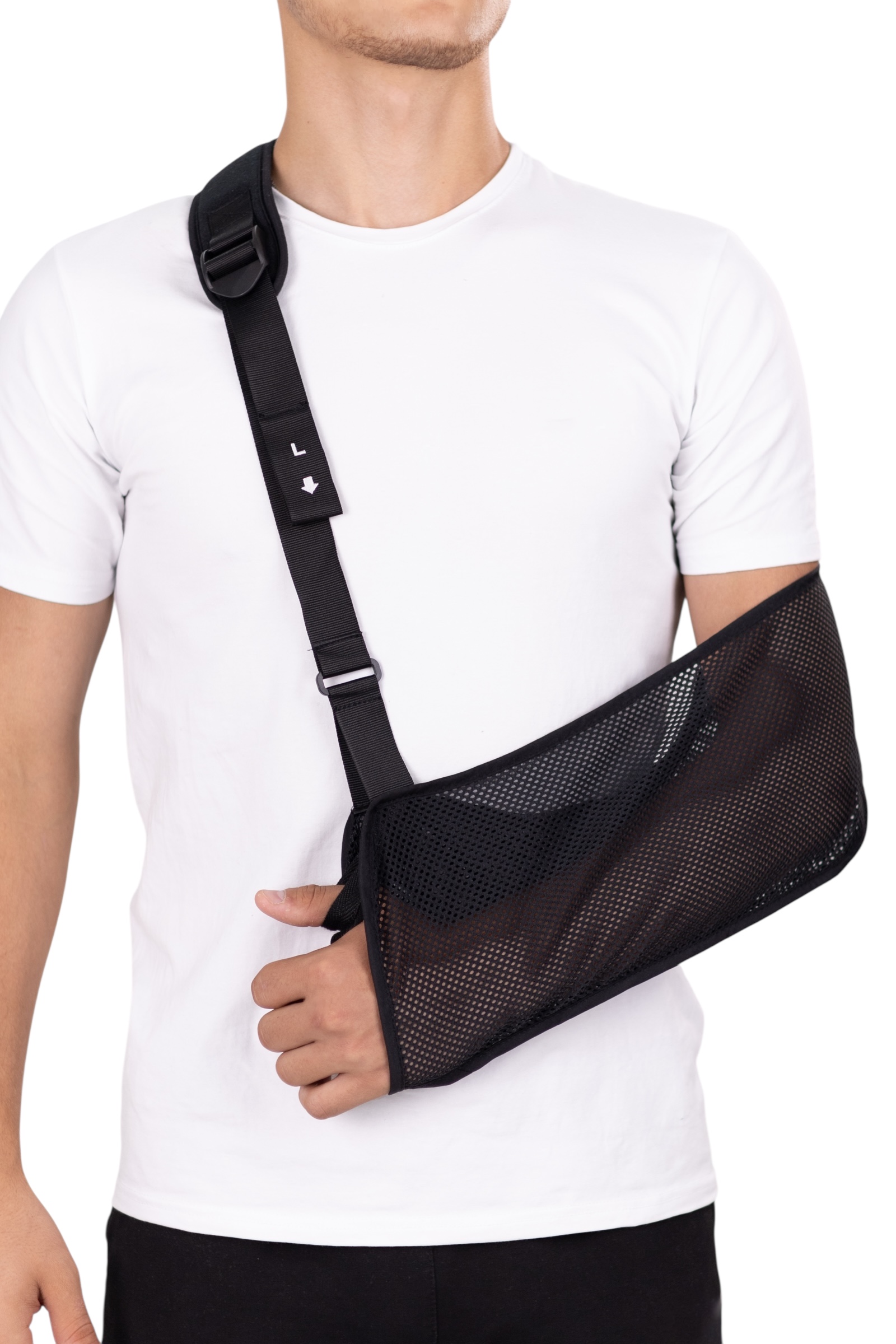
Before using, you must carefully read the instructions for the specific product. The hand is placed in the supporting part so that it is in the recommended position. After that, the straps or other structural elements are fixed.
It is important that the bandage does not squeeze the hand. The fingers should not go numb, turn blue or become cold. If after putting on, severe pain appears, swelling increases or sensitivity disorders occur, the product must be removed and consult a doctor.
The duration of wearing also depends on the nature of the injury. You should not increase or decrease the time of using the brace yourself if the doctor has recommended a certain regimen.
Is a brace needed after a fracture?
After an upper limb fracture, the doctor may prescribe additional support for the arm at a certain stage of recovery. The brace helps to hold the limb and reduce its load during the vertical position of the body.
However, after a fracture, you cannot independently determine which brace is needed. In some cases, a supporter is sufficient, while in others, rigid fixation is required. This depends on the location and nature of the fracture, the stage of healing, and the recommendations of the traumatologist.
Where to buy a hand brace?
If you need to buy a brace for the elbow, shoulder, wrist, or a supporter for the entire arm, the first thing to do is determine the purpose of the product. The correctly selected design should correspond to the fixation area and the recommendations of the specialist.
For situations where it is necessary to support the arm as a whole, a supportive arm bandage in the form of a scarf can be a convenient solution. It can be used to support the limb when it needs additional support and load limitation.
If you need to buy a wrist bandage, you should not choose a scarf instead of a special fixator: these products have different purposes.
Frequently asked questions about the hand scarf bandage
1. Which hand - right or left - will the hand scarf bandage fit?
The hand scarf bandage can be used to support both the right and left hand. The universal design allows you to place the limb on the desired side without having to buy a separate product for the right or left hand. Before use, it is important to correctly adjust the bandage so that the hand is securely fixed and does not feel excessive pressure.
2. How long can you wear such a bandage?
The duration of use depends on the reason for which you need to support your arm and the doctor's recommendations. After injuries or operations, the wearing regimen is determined by a specialist. If the bandage is used only for temporary support of the arm, it can be removed during rest according to the recommendations. You should not wear a fixator yourself 24 hours a day for a long time without need.
3. How does a hand bandage differ from an orthosis?
A bandage usually provides soft support and helps to keep the limb in a comfortable position. An orthosis can have rigid or semi-rigid elements and provide more pronounced fixation of a certain area. For example, an elbow joint orthosis is designed to stabilize the elbow itself, while a handkerchief bandage supports the arm as a whole. Therefore, the choice between a bandage and an orthosis depends on the specific situation and the recommendations of a specialist.
4. Does the bandage have sizes or is it universal?
It depends on the specific model. Bandana bandages often have a universal size and adjustable straps, thanks to which they can be adapted to the user's parameters. Before buying a hand bandage, it is worth checking the information about the size and adjustment range specified by the manufacturer.
5. Can an elbow bandage be washed?
The possibility of washing depends on the materials and design of the specific product. If the manufacturer provides care for the bandage, it is necessary to follow the recommendations on the label or in the instructions. For many textile models, hand or delicate washing without aggressive detergents is recommended. Before washing, it is necessary to remove all removable elements, if provided for by the design, and do not use high temperatures without the appropriate permission of the manufacturer.